Conquer the Khumbu : A Distinctive Guide to Trekking Near Everest
The Everest region, known locally as Khumbu, is the crown jewel of Himalayan trekking. Home to four of the world’s six highest peaks—Everest, Lhotse, Makalu, and Cho Oyu—this UNESCO World Heritage site offers a profound blend of extreme high-altitude adventure and rich Sherpa culture.In below there is description of best everest region treks.
Whether you are looking for the classic “bucket list” journey or a quiet escape to turquoise glacial lakes, the region provides diverse routes tailored to different levels of experience.
Mount Everest (8,848m) radiates a quiet yet irresistible pull—one that entices not only hardened alpinists but also those who admire mountains from the comfort of imagination. Despite the occasional congestion along its principal routes, the Khumbu region—Everest’s inner sanctum—retains a grandeur that refuses to be diluted.
While Everest commands global reverence, its surrounding sentinels frequently captivate with even greater immediacy. Lhotse (8,501m), Nuptse (7,861m), and Lobuche West (6,145m) rise in commanding formation, composing a skyline that feels almost theatrical. Their proximity and sharp contours create a visual intensity that often surpasses Everest’s distant silhouette.
Why Step Into the Everest Region?
The Everest region has evolved into Nepal’s most structured trekking enclave, yet it retains a raw, untamed essence beneath its polished surface. Here, adventure is paired with an unexpected degree of ease.
Refined Trails: Routes are thoughtfully maintained, enabling smoother passage through otherwise formidable terrain.
Comfort Amid Wilderness: Teahouses provide not just refuge but warmth, familiarity, and a surprising level of hospitality.
Streamlined Access: Standard trekking itineraries avoid excessive permit complications, and heavy camping logistics are largely unnecessary.
Culinary Breadth: Even at altitude, menus stretch beyond expectation, blending local and international flavors.
Altitude Advisory: Much of the region rises above 5,000 meters, where oxygen scarcity becomes a tangible challenge. The threat of Acute Mountain Sickness (AMS) is real, and success hinges on restraint—slow pacing and deliberate acclimatization are indispensable.
Everest Trekking Packages Overview
The Everest Base Camp trek remains Nepal’s most iconic trekking narrative—a journey that transitions from lush, breathing valleys to stark, wind-sculpted highlands.
Ideal For: Legendary vistas and a sense of personal triumph
Difficulty: Moderate to demanding
Maximum Elevation: 5,545m at Kala Patthar
Start/End Point: Lukla
The Journey Unfolds
The adventure typically begins with a dramatic airstrip landing in Lukla, followed by a gradual ascent toward Namche Bazaar—a vibrant hub often regarded as the Sherpa capital. Spending a couple of nights here is not merely advisable but vital, allowing the body to adapt while offering time to explore monasteries and local heritage.
Moving onward, the trail threads through Tengboche, home to a revered monastery, and Pangboche, where folklore whispers of elusive yeti relics. Gradually, verdant forests surrender to a stark, almost lunar terrain, where altitude reshapes both landscape and perception.
Surprisingly, Everest’s summit remains hidden from Base Camp itself. During the spring climbing season—particularly April to May—the area transforms into a bustling expanse of expedition tents, alive with anticipation. In contrast, autumn strips it back to a quiet, almost desolate expanse.
The true crescendo lies at Kala Patthar (5,545m). At first light, the horizon ignites—revealing the Khumbu Icefall, Nuptse, Lhotse, and Everest rising in layered magnificence. It is here, rather than Base Camp, that the mountain reveals its most iconic face.
A Note on Crowds
As Nepal’s most celebrated trekking route, solitude is a rare luxury along this path. Encounters with fellow trekkers are inevitable. Yet, this popularity brings undeniable advantages—reliable facilities, connectivity, and comforts such as heated lodges and hot showers.
For some, the shared journey enhances the experience; for others, it may feel overwhelming. The decision ultimately rests on whether one seeks companionship or quietude in the high Himalaya.
Gokyo Lakes Trek: A Serene Himalayan Detour
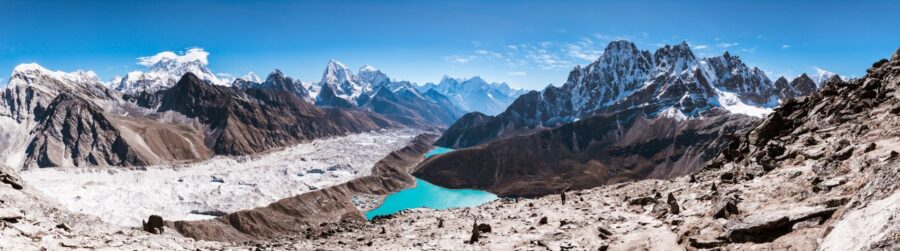
For those who crave the splendor of the Everest region yet wish to sidestep the dense procession of trekkers bound for Base Camp, the Gokyo Lakes route emerges as an exquisite alternative. Instead of barren, dust-laden moraines, this trail unveils a chain of glacial lakes shimmering in deep sapphire hues—each one reflecting the surrounding giants like a fractured mirror of the sky.
Ideal For: Striking alpine scenery paired with relative solitude
Difficulty: Moderate leaning toward demanding
Maximum Elevation: 5,360m at Gokyo Ri
Start/End Point: Lukla
The Road Less Followed
The journey initially mirrors the classic Everest Base Camp trail, threading through familiar terrain. However, beyond Namche Bazaar, at the quiet junction of Sanasa, the narrative shifts. While the majority press onward toward Everest, your path diverts into the tranquil embrace of the Dudh Kosi Valley.
Here, the environment undergoes a subtle yet profound transformation. Dense forests gradually dissolve into expansive yak pastures, eventually giving way to stark glacial formations that feel both ancient and untamed.
Gokyo’s Quiet Grandeur
After roughly a week of steady trekking, the remote settlement of Gokyo reveals itself—perched beside luminous lakes that seem almost otherworldly. Lingering here is not optional; it is essential.
Gokyo Ri (5,360m): A defining ascent that rewards effort with a sweeping Himalayan panorama. From the summit, a chain of turquoise lakes unfolds beneath towering peaks, including Mount Everest itself.
The Sacred Lakes Circuit: A contemplative excursion further into the valley, leading to Scoundrel’s Viewpoint (5,000m), where the mountains reveal a quieter, less-traveled face.
Pro Insight: Altitude here is not to be taken lightly. The temptation to push forward quickly can be costly. Allow your body the time it demands—rest days are not delays but investments in safety.
The Three Passes Trek: The Definitive Himalayan Trial
For trekkers driven by endurance and an appetite for challenge, the Three Passes Trek stands as the ultimate proving ground. It is not merely a trek—it is a full-spectrum Himalayan immersion, often regarded as the most rewarding lodge-based circuit in Nepal.
Ideal For: High-altitude enthusiasts seeking a comprehensive Everest experience
Difficulty: Strenuous and physically exacting
Duration: 18–20 days (with additional days recommended for side explorations)
Maximum Elevation: 5,535m at Kongma La (or 5,545m including Kala Patthar)
The Grand Circuit
True to its name, this route threads together three formidable mountain passes, each demanding both stamina and resolve:
Kongma La (5,535m)
Cho La (5,420m)
Renjo La (5,360m)
By linking these crossings, trekkers experience the Everest region in its entirety—Everest Base Camp, the tranquil Gokyo Lakes, and iconic viewpoints such as Kala Patthar and Gokyo Ri. Many begin the circuit from Dingboche, approaching Kongma La first to better align with acclimatization needs.
Safety and Preparation
This is far removed from a leisurely walk. The terrain can be technical, the weather volatile, and the margin for error slim. Preparation must be meticulous.
Engage a knowledgeable guide and reliable porter
Carry essential gear such as crampons and, when necessary, an ice axe
Remain mentally prepared for unexpected delays—even an unplanned overnight stay due to weather conditions
In this realm, adaptability is as crucial as strength. The mountains do not yield easily—but for those who persist, the rewards are nothing short of extraordinary.
Jiri or Shivalaya to Lukla: The Heritage Trail Reimagined
To set foot on this path is to step into a slower, older rhythm of the Himalayas—long before aircraft stitched Lukla to the outside world. This was once the lifeline of early Everest expeditions, a route etched not just into the landscape but into mountaineering history itself.
Ideal For: Travelers drawn to cultural depth rather than altitude extremes
Difficulty: Easy to moderate, though deceptively strenuous
Duration: 9–10 days
Maximum Elevation: 3,530m
Why This Route Still Matters
Unlike the dramatic skyline of the upper Khumbu, this trail reveals a subtler narrative—one rooted in everyday life.
Cultural Immersion: Beginning from Kathmandu and extending through Jiri or Shivalaya, the journey winds through villages predominantly inhabited by the Rai community. Terraced fields cascade down hillsides, and daily routines unfold untouched by the bustle of modern trekking corridors.
Physical Reality: Though labeled “moderate,” the trail demands endurance. Expect relentless ascents and descents—plunging into humid valleys before climbing steep ridgelines that test both stamina and patience.
Practical Advantage: Reaching the trailhead by road eliminates the uncertainties of flights, offering a grounded and often more reliable start to the adventure.
This route is less about spectacle and more about connection—a quieter, more introspective Himalayan experience.
Makalu to Everest: The Grand Traverse of Extremes
If most treks flirt with adventure, this one commits fully. The Makalu to Everest traverse is not merely demanding—it is an expedition that straddles the boundary between trekking and high-altitude mountaineering.
Ideal For: Highly experienced trekkers craving isolation and technical challenge
Difficulty: Extremely strenuous, bordering on alpine expedition level
Duration: Approximately 30 days
Maximum Elevation: 6,146m at Sherpani Col
The Technical Core
This formidable journey stitches together the remote Makalu region with the Everest domain via a trio of glaciated passes:
Sherpani Col (6,146m)
West Col (6,143m)
Amphu Labtsa (5,848m)
Here, isolation is absolute. Nights are often spent above 5,000 meters, far removed from any immediate escape. The terrain demands technical fluency—ropes, crampons, and ice navigation are not optional tools but essential companions.
Only those equipped with experience, resilience, and a capable expedition team should attempt this traverse. It is less a trek and more a test of human limits.
Numbur Cheese Circuit: Wilderness with Character
Tucked away from mainstream trekking maps, the Numbur Cheese Circuit offers a refreshing divergence—where biodiversity and local livelihood intertwine seamlessly.
Ideal For: Nature lovers and those seeking quiet, lesser-known trails
Difficulty: Moderate
Duration: 14–16 days
Maximum Elevation: 4,880m at Gyajo La
What Sets It Apart
Untamed Nature: Dense rhododendron forests shelter elusive wildlife, including the rare red panda and musk deer.
Sacred Landscapes: High-altitude lakes such as Jata Pokhari and Panch Pokhari lend a spiritual dimension to the journey.
Artisanal Identity: The region is renowned for yak cheese production, offering trekkers a chance to sample locally crafted delicacies directly from the source.
Accommodation Style: Expect simplicity—homestays interwoven with occasional camping, enhancing the sense of immersion.
This is a trek where silence speaks louder than crowds, and authenticity defines every step.
Island Peak (Imja Tse): The Gateway to Alpine Ambition
Rising to 6,189 meters, Island Peak stands as a threshold between trekking and true mountaineering. Though labeled a “trekking peak,” it demands respect, preparation, and technical awareness.
Ideal For: Trekkers transitioning into mountaineering pursuits
Difficulty: Strenuous with technical elements
Duration: Around 6 days (typically combined with Everest Base Camp trek)
Maximum Elevation: 6,189m
What Awaits on the Ascent
Approached via the village of Chhukung, the climb introduces trekkers to the fundamentals of alpine technique. Crampons bite into ice, ropes guide upward movement, and an exposed headwall near the summit demands both courage and composure.
While less complex than major Himalayan expeditions, Island Peak offers a genuine taste of mountaineering—an initiation that transforms trekkers into climbers.
For many, it is not just a summit, but the beginning of a deeper relationship with the mountains.
Everest Trekking: The Defining Himalayan Highlights
Mount Everest—revered in Tibetan as Qomolangma, or “Mother Earth”—stands as the unchallenged monarch of the Khumbu. Since the landmark ascent in 1953 by Tenzing Norgay and Edmund Hillary, the journey toward its base has transformed into something far greater than a trek—it has become a global rite of passage.
The Peak Experiences
Legendary Viewpoints
While Everest Base Camp itself rests amid rugged moraines with surprisingly limited summit visibility, nearby vantage points reveal the mountain in its full majesty.
Kala Patthar (5,545m) delivers the quintessential panorama—Everest rising in layered dominance above the Khumbu Icefall.
Gokyo Ri (5,360m) offers an entirely different spectacle, where turquoise lakes and sprawling glaciers compose a dreamlike Himalayan canvas.
Each viewpoint tells a different story—one bold and immediate, the other serene and expansive.
High-Altitude Passes
For trekkers seeking a more immersive confrontation with the Himalayas, crossing the great passes of the Three Passes Trek offers an unparalleled perspective. At elevations exceeding 5,000 meters, the environment becomes unforgiving—oxygen thins, winds sharpen, and the cold settles deep. Yet, the reward is a raw, unfiltered panorama that few landscapes on Earth can rival.
Trekking Peaks
For those unwilling to stop at trekking, the Khumbu presents an invitation to climb.
Island Peak (6,189m) stands as the most approachable gateway into mountaineering.
Lobuche East (6,119m) and Kusum Kangru (6,367m) escalate the challenge, demanding greater technical precision and endurance.
These peaks blur the boundary between trekking and true alpine climbing, offering progression for those ready to push further.
Cultural and Exploratory Dimensions
Sherpa Heritage
The Khumbu is more than a trekking destination—it is the ancestral homeland of the Sherpa people. Beyond the trails, spiritual life pulses quietly through ancient monasteries such as Tengboche Monastery, where prayer flags flutter against a backdrop of snow peaks.
Seasonal festivals add further depth:
Mani Rimdu (October–November), marked by masked dances and ritual ceremonies
Gyalpo Losar (February–March), celebrating renewal and community
Strategic Side Explorations
To truly grasp the breadth of the region, one must occasionally step away from the main artery:
Wander into the Imja Khola Valley for a quieter alpine experience
Ascend toward Khumjung from Namche to witness traditional Sherpa life
Follow ancient trade corridors through the Bhote Kosi Valley, once linking Nepal to Tibet
These detours often reveal the soul of the Khumbu more vividly than the main trail itself.
Essential Everest Trekking Insights
When Should You Go?
The trekking season spans from October through April, each window offering a distinct character:
Peak Clarity: October to early November—crisp skies and unmatched visibility, though heavily trafficked
Balanced Window: December or late February to March—fewer trekkers with equally rewarding conditions
Avoid: Monsoon months (late May to early September), when rain clouds obscure the mountains and trails become challenging
Logistics at a Glance
Permits: Most routes require a TIMS card alongside entry to Sagarmatha National Park. More remote routes may involve additional conservation permits.
Accommodation: Teahouses dominate the landscape, often equipped with modern comforts such as Wi-Fi and hot showers. Higher-end lodges are also available in key hubs.
Transport: The journey typically begins with a flight to Lukla Airport. Given the region’s volatile weather, allowing buffer days is not just wise—it is necessary.
How Demanding Is It?
Every trek within the Everest region carries an inherent challenge shaped by altitude and climate.
Moderate to Challenging: Everest Base Camp, Gokyo Lakes
Physically Grueling: The Jiri to Lukla heritage route, with relentless ascents and descents
Highly Demanding: The Three Passes Trek or Makalu–Everest traverse, where endurance meets technical complexity
In the end, trekking in the Everest region is not merely about reaching a destination—it is about surrendering to a landscape that reshapes perception. Each step unfolds a deeper layer of the Himalayas, where nature, culture, and personal endurance converge into something profoundly transformative.