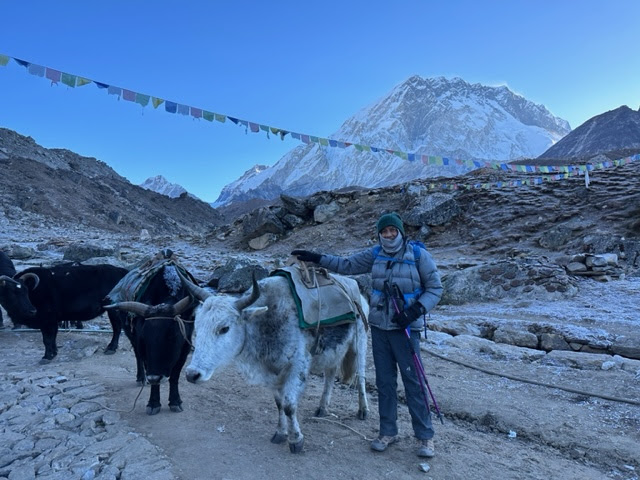
The Everest Base Camp Trek in November is one of the best choices for trekkers who want clear Himalayan views, dry trails, comfortable daytime walking conditions, and a more relaxed atmosphere than the busiest part of autumn.
November sits at the end of Nepal’s main autumn trekking season. The monsoon has already disappeared, the skies are generally clear, and winter has not yet fully taken over the high valleys. This creates a particularly attractive combination for walking through the Khumbu region.
The journey takes you from Lukla through Phakding, Namche Bazaar, Tengboche, Dingboche and Lobuche before reaching Everest Base Camp at 5,364 meters. Many trekkers also climb Kala Patthar for one of the finest viewpoints of Mount Everest and the surrounding peaks.
The most important thing to remember is that November does not mean warm weather. Conditions become increasingly cold as you gain altitude, especially after Dingboche. Good clothing, proper acclimatization, travel insurance and a sensible itinerary are therefore essential.
If you are considering an Everest Base Camp trek in November, this guide explains what you can realistically expect, including weather, temperature, trail conditions, crowds, accommodation, flights, difficulty, packing, permits, costs and practical preparation.
Is November a Good Time for the Everest Base Camp Trek?
Yes, November is one of the best months for the Everest Base Camp Trek.
The Everest region generally experiences dry and stable conditions during October and November, which are officially listed among the better seasons for visiting the area.
There are several reasons November is particularly attractive:
- Clear mountain visibility
- Very little rainfall
- Generally dry trekking trails
- Pleasant conditions for daytime hiking at lower elevations
- Excellent views of Everest and surrounding peaks
- Less congestion than the busiest periods of October
- Most tea houses and trekking facilities remain operational
- Beautiful autumn landscapes at lower elevations
- Excellent conditions for mountain photography
However, November has two distinct personalities.
Early November can still feel like the peak autumn season. Trails may be lively, accommodation can be busy, and daytime weather is usually favorable.
Late November feels noticeably more wintry. Temperatures fall, especially at night, and the number of trekkers gradually decreases.
This means choosing the first half or second half of November can make a meaningful difference to your experience.
What Makes the Everest Base Camp Trek in November Special?
The Everest Base Camp trek is spectacular throughout the year, but November offers a particular combination of scenery and weather.
After months of monsoon rainfall, the atmosphere is generally much clearer. The surrounding mountains appear sharp against deep blue skies, and long-distance visibility is often excellent.
As you walk higher, the landscape changes dramatically.
The green hills and forests around Lukla gradually give way to pine and rhododendron woodland. Near Namche, the landscape becomes more rugged. Beyond Tengboche, trees become increasingly sparse, while the landscape around Dingboche, Lobuche and Gorak Shep becomes distinctly alpine.
You may see some of the world’s most famous Himalayan peaks, including:
- Mount Everest
- Lhotse
- Nuptse
- Ama Dablam
- Thamserku
- Kongde
- Cho Oyu
- Pumori
The mountains are only one part of the experience. The trek also passes through Sherpa settlements, Buddhist monasteries, prayer wheels, mani walls, suspension bridges and high-altitude valleys.
Namche Bazaar and Tengboche are especially important cultural stops. The Nepal Tourism Board describes the Everest region as a destination combining trekking, mountaineering and Sherpa culture, with tea houses and lodges available along the route.
Everest Base Camp Trek Weather in November
November is generally dry and stable, but the weather changes considerably with elevation.
At lower elevations, afternoons can feel pleasantly cool when the sun is out. At higher elevations, temperatures can remain close to freezing even during daylight hours.
The most important difference is between daytime and nighttime.
You may start a morning hike wearing several layers and later remove some of them as the sun rises. Once the sun disappears, temperatures can fall quickly.
Typical November Conditions by Location
| Location | Approx. Elevation | General November Conditions |
|---|---|---|
| Lukla | 2,860 m | Cool mornings and pleasant afternoons |
| Namche Bazaar | 3,440 m | Chilly mornings, cool sunny days |
| Tengboche | 3,860 m | Cold mornings and evenings |
| Dingboche | 4,410 m | Cold, particularly after sunset |
| Lobuche | 4,910 m | Very cold nights and mornings |
| Gorak Shep | 5,164 m | Freezing conditions are common |
| Everest Base Camp | 5,364 m | Very cold and exposed |
| Kala Patthar | 5,545 m | Extremely cold around sunrise |
These figures should be treated as approximate rather than guaranteed forecasts. Mountain weather can change rapidly, and actual temperatures depend on altitude, wind, cloud cover and the specific date.
A November trek therefore requires preparation for both comfortable walking conditions and freezing high-altitude nights.
Everest Base Camp Temperature in November
Temperature is one of the biggest considerations when trekking to Everest Base Camp in November.
At lower elevations, daytime conditions can be quite comfortable for walking. The situation changes considerably above 4,000 meters.
Typical conditions may look roughly like this:
- Lukla: around 5–15°C during the day, colder at night
- Namche Bazaar: around 0–10°C during the day
- Dingboche: often below 5°C during the day and well below freezing at night
- Lobuche: daytime temperatures can remain around or below freezing
- Gorak Shep: freezing temperatures are common, especially overnight
- Kala Patthar: very cold and windy around sunrise
The exact temperature matters less than preparing for the range of conditions you could encounter.
A good layering system is much more useful than carrying one extremely heavy jacket.
Early November vs Late November
One of the most useful things to understand about an Everest Base Camp Trek in November is that the month changes noticeably from beginning to end.
Early November
Early November usually offers conditions closer to October.
You can expect:
- Clear skies
- Good mountain visibility
- Dry trails
- More trekkers
- More active tea houses
- Relatively comfortable daytime temperatures
- Cold but manageable mornings
For first-time trekkers who want a balance between good weather and an active trekking atmosphere, early November is an excellent option.
Mid-November
By the middle of the month, temperatures begin to fall.
The trail becomes quieter, particularly at higher elevations, while daytime hiking can still be pleasant under clear skies.
This period can be a good compromise for travelers who want fewer people without moving too deeply into winter conditions.
Late November
Late November can be significantly colder.
The advantages include:
- Fewer trekkers
- Quieter trails
- Peaceful villages
- Excellent visibility when skies are clear
The disadvantages are colder nights, greater exposure to freezing temperatures and a higher possibility of early winter conditions at the highest elevations.
If you choose late November, make sure your sleeping bag and insulation system are suitable for sub-zero nights.
Trail Conditions on the Everest Base Camp Trek in November
November generally provides favorable trail conditions.
The summer monsoon has already ended, so muddy sections and heavy rain are much less of a concern. At lower elevations, the trail is usually firm and comfortable for walking.
As you approach the higher valleys, the character of the trail changes.
Around Lobuche, Gorak Shep and Everest Base Camp, frozen ground and icy sections can occur, particularly early in the morning or later in November.
You should therefore bring:
- Hiking boots with good traction
- Trekking poles
- Warm socks
- Microspikes if recommended by your guide
- Gloves
- A reliable headlamp
Do not assume that clear weather means the trail will always be easy. Altitude remains the biggest challenge.
Everest Base Camp Trek in November: Crowds
October is traditionally one of the busiest trekking periods in the Everest region.
By November, the number of trekkers gradually begins to decline.
This can make a noticeable difference.
You may find:
- Less crowded trails
- More relaxed tea-house environments
- Shorter queues at popular viewpoints
- More peaceful evenings
- Easier interaction with local hosts
- Better opportunities for photography without large groups
However, November is not an empty month.
The first part of November can still be busy because many international trekkers deliberately choose the autumn season for its reliable conditions.
If avoiding crowds is your priority, the second half of November is generally more attractive.
Lukla Flights in November
For the classic Everest Base Camp itinerary, Lukla is the traditional starting point. The Nepal Tourism Board describes Lukla as the gateway to Everest, with most trekkers beginning the journey there.
November usually provides more favorable flying conditions than the monsoon months because rainfall and persistent cloud cover are less common.
Nevertheless, a Lukla flight is never guaranteed simply because it is November.
Mountain weather can change quickly, and flights can be delayed or cancelled because of:
- Strong winds
- Poor visibility
- Cloud cover
- Airport operating conditions
- Aircraft availability
- Weather along the flight route
For this reason, it is wise to include at least one or two flexible days in your overall Nepal travel schedule.
If your international flight leaves Kathmandu immediately after the trek, even a small Lukla delay can create unnecessary stress.
Can You Trek to Everest Base Camp Without a Guide in November?
Current Nepal Tourism Board guidance lists the Everest Base Camp route among the trekking routes where trekkers must be accompanied by a licensed trekking guide and carry a trekking-agency-issued TIMS card under the revised TIMS provisions.
Beyond the regulatory requirement, a guide is particularly useful in November because the weather gets colder as you climb higher.
A professional guide can help with:
- Route navigation
- Daily pacing
- Accommodation arrangements
- Altitude monitoring
- Weather decisions
- Communication with tea houses
- Emergency coordination
- Recognizing symptoms of altitude sickness
A porter can also carry most of your heavy luggage, allowing you to walk with a lighter daypack.
Everest Base Camp Trek Difficulty in November
The Everest Base Camp Trek is considered a challenging high-altitude trek, regardless of the month.
November does not make the trek easy simply because the weather is generally favorable.
The main difficulties are:
High Altitude
Everest Base Camp sits at 5,364 meters, while Kala Patthar rises to approximately 5,545 meters.
At these elevations, the amount of oxygen available is substantially lower than at sea level.
Long Walking Days
Most trekking days involve several hours of walking.
The challenge comes from doing this repeatedly while gaining altitude.
Cold Temperatures
The cold becomes increasingly noticeable after Dingboche.
Steep and Uneven Sections
The trail contains stone steps, rocky paths, suspension bridges and long uphill sections.
Altitude Gain
The most important factor is not simply physical strength. Your body needs time to adapt to increasing elevation.
That is why a sensible itinerary includes acclimatization days.
Acclimatization During the EBC Trek
Acclimatization should never be treated as a wasted day.
The classic route normally includes acclimatization stops around Namche Bazaar and Dingboche.
On these days, you may take short hikes to higher elevations before returning to sleep at a lower altitude.
For example, from Namche you can explore the surrounding hills and viewpoints. From Dingboche, trekkers often hike toward higher viewpoints such as Nangkartshang.
The purpose is to expose your body to higher elevations without immediately sleeping at that altitude.
If you develop symptoms such as severe headache, unusual weakness, confusion, difficulty walking or breathing problems, inform your guide immediately and do not simply continue because you have a schedule to maintain.
Recommended Everest Base Camp Trek Itinerary for November
A 14-day itinerary is commonly used for the classic Everest Base Camp trek because it provides time for acclimatization and allows a gradual ascent.
Day 1: Kathmandu to Lukla and Trek to Phakding
Fly toward Lukla and begin walking through the Dudh Koshi valley.
Day 2: Phakding to Namche Bazaar
Follow the river, cross suspension bridges and enter Sagarmatha National Park before climbing toward Namche.
Day 3: Acclimatization in Namche
Spend the day exploring Namche and surrounding viewpoints.
Day 4: Namche to Tengboche
Walk through beautiful mountain landscapes toward Tengboche, home to its famous monastery.
Day 5: Tengboche to Dingboche
Continue through the Imja Khola valley toward the high-altitude settlement of Dingboche.
Day 6: Acclimatization in Dingboche
Take a short hike and allow your body to adjust to the altitude.
Day 7: Dingboche to Lobuche
The landscape becomes increasingly rugged as you approach the Khumbu Glacier.
Day 8: Lobuche to Gorak Shep and Everest Base Camp
Reach Gorak Shep and continue toward Everest Base Camp before returning to Gorak Shep.
Day 9: Kala Patthar and Trek to Pheriche
Start early for Kala Patthar and enjoy the sunrise over the Himalayan peaks before descending.
Day 10: Pheriche to Namche
Descend through the Khumbu valley.
Day 11: Namche to Lukla
Complete the final walking section to Lukla.
Day 12: Lukla to Kathmandu
Fly back to Kathmandu, subject to weather and flight operations.
Extra Days
It is sensible to keep additional contingency days because mountain flights and weather cannot be controlled.
The exact itinerary can also be modified according to your fitness, previous altitude experience and available time.
What Will You See on the November EBC Trek?
One of the strongest reasons to choose November is the scenery.
Mount Everest
The ultimate objective of the trek is reaching Everest Base Camp, but some of the best views of Everest actually come from viewpoints along the trail.
Ama Dablam
Ama Dablam is one of the most recognizable peaks in the Khumbu and appears dramatically from several sections of the trail.
Tengboche Monastery
Tengboche is both a cultural and scenic highlight.
The monastery sits in a beautiful mountain setting and provides an opportunity to experience the Buddhist traditions of the Sherpa communities.
Namche Bazaar
Namche is more than a place to sleep. It is the commercial and cultural center of the Khumbu and an important acclimatization stop.
Khumbu Glacier
As you approach Everest Base Camp, the landscape becomes dominated by glaciers, moraines and enormous Himalayan peaks.
Kala Patthar
For many trekkers, sunrise from Kala Patthar is the visual highlight of the entire journey.
From the summit, you can see Everest and several surrounding peaks in an extraordinary Himalayan panorama.
Wildlife in the Everest Region
The Everest region is not only about mountains.
Sagarmatha National Park contains a variety of Himalayan wildlife, including Himalayan tahr, musk deer, ghoral, pika and other species. The park is also home to numerous Himalayan birds, including the colorful Himalayan monal and blood pheasant.
November’s clear conditions can make wildlife observation and photography particularly enjoyable.
Still, wildlife sightings are never guaranteed. Keep a respectful distance and avoid feeding or disturbing animals.
Everest Base Camp Trek Permits in November
The permit requirements do not disappear during November.
For the standard Everest Base Camp route, trekkers need the relevant Sagarmatha National Park entry permit and the required local/TIMS documentation.
The Nepal Tourism Board currently lists the Sagarmatha National Park entry fee for foreign visitors at NPR 3,000 per person, while the listed fee for SAARC nationals is NPR 1,500.
The revised TIMS provisions also specifically include Everest Base Camp among the routes covered by the mandatory guide and TIMS requirement.
Because fees and procedures can change, it is best to confirm the current requirements with your trekking agency or the Nepal Tourism Board before departure.
Everest Base Camp Trek Cost in November
The total cost depends on how you organize the trip.
Your budget may include:
- International airfare
- Nepal visa
- Kathmandu accommodation
- Lukla flights or alternative transportation
- Trekking permits
- TIMS
- Guide
- Porter
- Tea-house accommodation
- Meals
- Drinking water
- Charging and internet
- Travel insurance
- Trekking equipment
- Tips
- Emergency transportation
November can still be a relatively expensive trekking period because it falls within the main autumn season.
The biggest mistake is choosing a trek based only on the advertised package price.
Before booking, check what is actually included.
For example, two packages with very different prices may offer different levels of accommodation, meals, transportation, guide services, porter support and insurance arrangements.
What to Pack for Everest Base Camp in November
Packing correctly is essential because conditions range from cool autumn weather at lower elevations to freezing conditions above 5,000 meters.
Clothing
- Moisture-wicking base layers
- Fleece or warm mid-layer
- Down or insulated jacket
- Waterproof/windproof outer jacket
- Trekking trousers
- Warm thermal trousers
- Wool or synthetic hiking socks
- Warm sleeping socks
- Gloves
- Warm hat
- Sun hat or cap
Footwear
- Good-quality trekking boots
- Lightweight camp shoes
- Several pairs of trekking socks
Sleeping Equipment
A good sleeping bag rated for cold conditions is highly recommended.
Tea houses provide blankets in many locations, but relying solely on lodge blankets is not a good strategy at high elevations in November.
Accessories
- Sunglasses with strong UV protection
- Sunscreen
- Lip balm
- Headlamp
- Trekking poles
- Water bottles
- Water purification tablets or filter
- Power bank
- Basic first-aid supplies
- Personal medications
- Toiletries
Documents
Carry copies of:
- Passport
- Visa
- Insurance details
- Permits
- Emergency contact information
Keep important documents protected from moisture.
Travel Insurance for the Everest Base Camp Trek
Travel insurance is strongly recommended for a high-altitude trek.
Your policy should be checked carefully rather than assuming that every travel insurance plan covers trekking.
Look for coverage that specifically addresses:
- High-altitude trekking
- Emergency medical treatment
- Helicopter evacuation
- Trip interruption
- Flight delays or cancellations
- Baggage loss
Most importantly, check the maximum altitude covered by your policy.
A policy that covers ordinary travel but excludes trekking above a certain elevation may not be suitable for Everest Base Camp.
Food and Accommodation in November
Tea houses remain the standard accommodation option on the classic Everest Base Camp route.
The Nepal Tourism Board confirms that lodges and tea houses are available throughout the Everest region.
Rooms are generally simple, with shared facilities becoming more common as you travel higher.
Typical meals include:
- Dal bhat
- Noodles
- Rice
- Pasta
- Soups
- Potatoes
- Eggs
- Momos
- Bread
- Porridge
- Tea and coffee
At high elevations, menus may become smaller because transporting supplies becomes increasingly difficult.
Dal bhat remains one of the most practical trekking meals because it provides carbohydrates, protein and a substantial amount of energy.
How to Stay Healthy at High Altitude
Good fitness is useful, but altitude affects everyone differently.
You should:
- Ascend gradually.
- Take acclimatization days seriously.
- Drink enough fluids.
- Eat regularly.
- Avoid excessive alcohol.
- Sleep adequately.
- Walk at a comfortable pace.
- Tell your guide if you feel unwell.
- Never ignore serious altitude symptoms.
- Descend if your condition requires it.
Do not try to prove your toughness by hiding symptoms.
The safest trek is the one where you listen to your body and make sensible decisions.
Fitness Preparation for November
You do not need mountaineering experience to trek to Everest Base Camp, but you should prepare physically.
Begin training several weeks or months before departure.
Useful activities include:
- Hiking
- Stair climbing
- Incline treadmill walking
- Long-distance walking
- Cycling
- Swimming
- Strength training
- Squats and lunges
Try to include regular uphill walking while carrying a light backpack.
The goal is not to become an elite athlete. It is to make several consecutive days of mountain walking feel manageable.
Advantages of Everest Base Camp Trek in November
There are many reasons November remains popular.
1. Excellent Mountain Visibility
Clear conditions can provide spectacular views of Everest and the surrounding peaks.
2. Dry Trails
The monsoon has ended, reducing rain-related trail problems.
3. Comfortable Walking Conditions
Lower and middle elevations can offer pleasant daytime temperatures.
4. Fewer Crowds Than Peak Autumn
The number of trekkers generally decreases as November progresses.
5. Great Photography
Clear skies, snowy peaks and warm morning and evening light create excellent photography conditions.
6. Operating Tea Houses
The main trekking infrastructure is still functioning during November.
7. Strong Himalayan Atmosphere
The transition from autumn toward winter gives the landscape a distinctly crisp and dramatic character.
Disadvantages of Trekking to EBC in November
November is excellent, but it is not perfect.
Cold Nights
Temperatures can fall well below freezing at higher elevations.
Busy Early November
The first part of November may still have considerable trekking traffic.
Increasing Cold Later in the Month
Late November requires better cold-weather equipment.
Lukla Flight Uncertainty
Even in a generally favorable season, mountain flights can be delayed.
High-Altitude Risk
Clear weather does not eliminate altitude sickness.
Shorter Comfortable Walking Window
As the month progresses, mornings and evenings become increasingly cold.
Who Should Choose the November EBC Trek?
November is particularly suitable for:
- First-time Everest trekkers
- Photographers
- Mountain-view enthusiasts
- Travelers who prefer dry weather
- Trekkers who want fewer crowds than October
- People comfortable with cold temperatures
- Hikers with reasonable fitness
If you dislike cold temperatures, early November is preferable to late November.
If your priority is quieter trails, late November may be more appealing.
Tips for a Successful Everest Base Camp Trek in November
Start Early
Morning starts are useful because mountain weather can change later in the day.
Dress in Layers
Layering lets you adjust to changing temperatures without carrying excessive clothing.
Protect Yourself From the Sun
At high altitude, strong sunlight can be intense even when the air feels cold.
Keep Electronics Warm
Cold temperatures can reduce battery life. Store batteries and power banks somewhere insulated when possible.
Carry Some Extra Cash
ATMs and card facilities are not equally reliable throughout the high-altitude region.
Drink Plenty of Water
Cold weather can make you forget to drink, but hydration remains important.
Keep a Flexible Schedule
Do not build an itinerary so tight that one flight delay ruins your international travel plans.
Respect Local Culture
Walk respectfully through villages, ask before photographing people and follow local customs around monasteries and religious sites.
Leave No Trace
Carry waste back when disposal facilities are unavailable and avoid damaging vegetation or wildlife.
Frequently Asked Questions About Everest Base Camp Trek in November
Is November the best month for Everest Base Camp?
November is one of the best months, particularly for trekkers who value clear skies and dry conditions. October and November are both recognized as favorable periods for visiting the Everest region.
Is Everest Base Camp cold in November?
Yes. The lower valleys can be comfortable during sunny afternoons, but temperatures become very cold at higher elevations. Nights around Gorak Shep and other high settlements can fall well below freezing.
Does it snow on the Everest Base Camp trek in November?
Snow is possible at high elevations, particularly later in the month, but November is generally much drier than the winter period.
Is November crowded on the EBC trail?
Early November can still be busy because it remains part of the main autumn trekking season. Crowds generally decrease as the month progresses.
Are tea houses open in November?
Yes. The main Everest Base Camp route has established tea houses and lodges, and the Everest region’s tourism infrastructure operates during this period.
Can beginners trek to Everest Base Camp in November?
Yes, a reasonably fit beginner can complete the trek with proper preparation, a gradual itinerary, acclimatization and professional guidance. Previous high-altitude trekking experience is helpful but not mandatory.
How high is Everest Base Camp?
The South Base Camp in Nepal is approximately 5,364 meters (17,598 feet) above sea level.
How high is Kala Patthar?
Kala Patthar reaches approximately 5,545 meters, depending on the elevation reference used.
Do I need a guide for Everest Base Camp in November?
Current Nepal Tourism Board guidance lists Everest Base Camp among the routes requiring a licensed trekking guide and trekking-agency-issued TIMS card under the revised provisions.
Do I need travel insurance?
Yes. For a high-altitude trek, comprehensive travel insurance that covers trekking at the required altitude and emergency evacuation is strongly recommended.
Is late November good for EBC?
Late November can be excellent for trekkers who prefer quieter trails and can handle colder conditions. However, you should be prepared for increasingly wintry weather.
Final Thoughts: Should You Trek to Everest Base Camp in November?
The Everest Base Camp Trek in November offers one of the most attractive combinations of scenery and trekking conditions available in Nepal.
The monsoon is long gone. The skies are generally clear. Mountain visibility can be exceptional, the trails are usually dry, and the trekking infrastructure remains active. At the same time, the crowds gradually begin to thin as the month moves toward winter.
The trade-off is cold.
You need to take the temperature seriously, particularly above Dingboche. A warm sleeping bag, proper layers, good footwear and appropriate insurance can make a major difference to your comfort and safety.
If you want the best balance between favorable weather and fewer crowds, early to mid-November is an especially strong choice. If solitude matters more to you and you are comfortable with significantly colder conditions, late November can also be rewarding.
Ultimately, reaching Everest Base Camp is not just about standing beneath the world’s highest mountain. It is about walking through Sherpa villages, crossing suspension bridges over glacial rivers, visiting monasteries, adapting to thin mountain air and experiencing the enormous scale of the Khumbu Himalayas.
With a well-planned itinerary and proper preparation, November can be an exceptional time to make that journey.