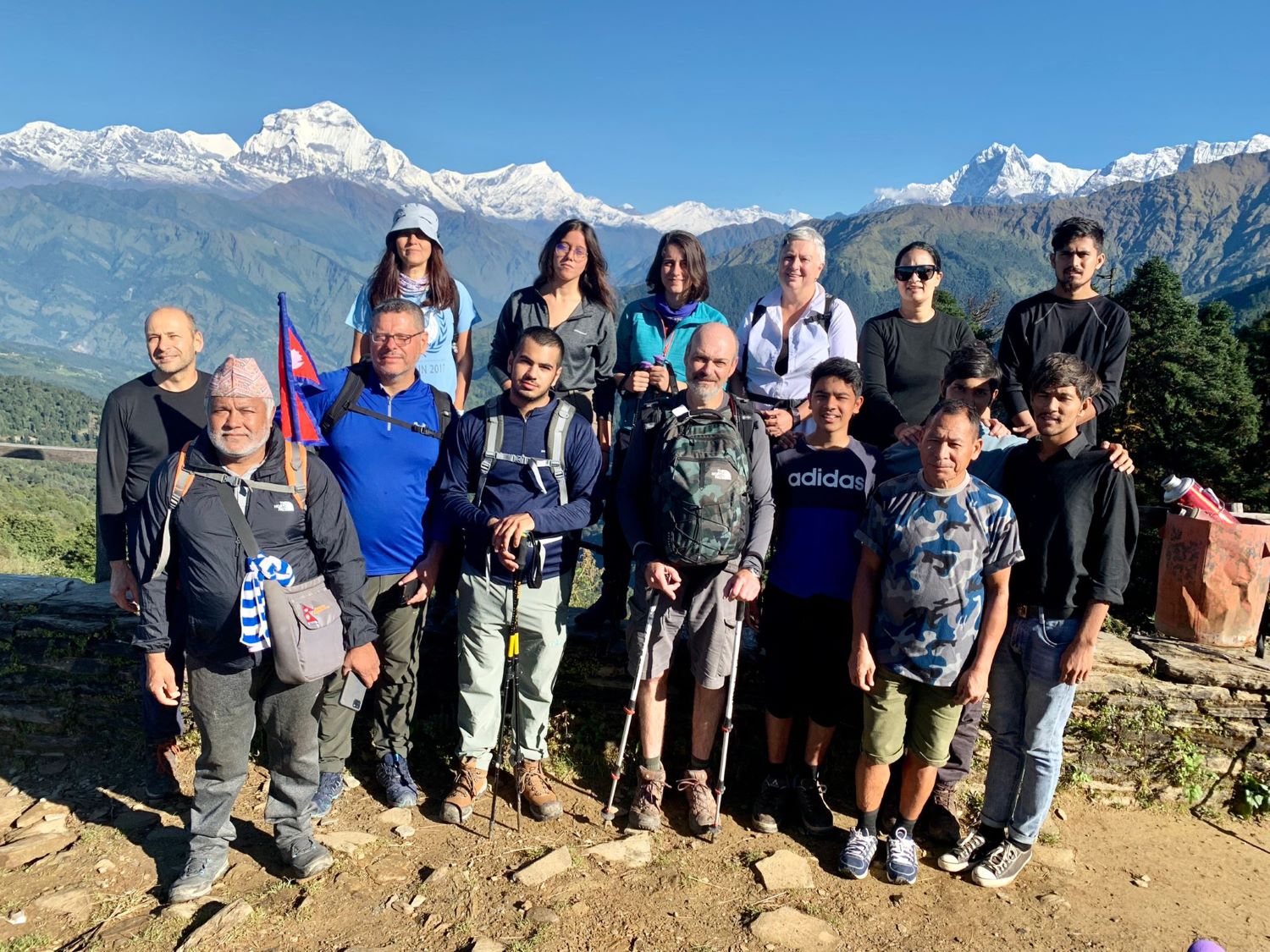
Where golden sunrises paint 8,000-meter giants, rhododendron tunnels frame ancient villages, and the world’s greatest mountain range reveals itself in just six to nine days.
There comes a moment on every Himalayan trek when you round a bend in the trail and the mountains simply appear—not gradually, but all at once, as if someone has peeled back the sky itself. On the Annapurna Panorama Trek (also affectionately known as the Ghorepani Poon Hill Trek), that moment happens again and again. Around nearly every corner of this storied trail, a new snow-capped summit reveals itself: the fish-tail silhouette of Machhapuchhre, the massive wall of Dhaulagiri, the serrated ridges of Annapurna South.
What makes this trek extraordinary isn’t just the views—it’s the accessibility. You don’t need mountaineering experience, weeks of vacation, or the lung capacity of a Sherpa. You need a pair of sturdy boots, a spirit of curiosity, and the willingness to wake up before dawn for one of the most celebrated sunrises on Earth.
What Is the Annapurna Panorama Trek?
The Annapurna Panorama Trek is a short to moderate teahouse trek in Nepal’s Annapurna Conservation Area, the country’s first and largest protected region. Unlike its more demanding siblings—the Annapurna Circuit and Annapurna Base Camp—this route stays at relatively lower elevations (maximum altitude: 3,210 meters / 10,531 feet at Poon Hill), making it one of the safest and most welcoming Himalayan experiences for first-timers.
The trek typically spans 6 to 9 days, depending on whether you start from Pokhara or Kathmandu and how much exploration time you build in. The standard route covers approximately 57 kilometers of well-maintained trails, winding through terraced farmlands, ancient oak and rhododendron forests, and traditional Gurung and Magar villages that have changed little over centuries.
The Crown Jewel: Sunrise from Poon Hill
If the Annapurna Panorama Trek has a heartbeat, it is Poon Hill.
At 3,210 meters, this modest viewpoint delivers one of the most staggering 360-degree panoramas in the Himalayas. The pre-dawn climb from Ghorepani takes 45 minutes to an hour—mostly stone steps that reward every labored breath with expanding views of the night sky giving way to morning.
Then, the sun rises.
As golden light spills across the horizon, it ignites a procession of Himalayan giants: Annapurna I (the 10th highest mountain in the world at 8,091m), Annapurna South, Hiunchuli, the iconic Machhapuchhre (Fishtail), Dhaulagiri (the 7th highest peak), and on clear days, even distant Manaslu and Nilgiri. The valleys below, dotted with terraced fields and slate-roofed villages, glow in the amber light. It is the kind of moment that reduces seasoned travelers to silence and turns first-time trekkers into lifelong mountain lovers.
The best part? Because Poon Hill is a day-hike destination from Ghorepani, you can also catch the sunset if weather permits—watching the peaks fade from gold to rose to deep violet as the stars emerge.
A Journey Through Living Culture
While the mountains dominate the skyline, the soul of this trek lies in its villages. The trail passes through settlements inhabited by the Gurung and Magar peoples, ethnic communities renowned for their warmth, resilience, and rich traditions.
Ghandruk is perhaps the most famous of these—a large Gurung village perched on a hillside with commanding views of Annapurna South and Machhapuchhre. Here, stone houses with carved wooden balconies cluster along narrow lanes. In the evening, you might visit the local Gurung Museum, share a cup of tea with a family, or simply watch the sunset paint the peaks from a lodge terrace.
Landruk offers a quieter, more intimate experience. Smaller and less touristy than Ghandruk, it provides an unfiltered glimpse into daily mountain life—farmers tending terraced fields, children walking to school along the trail, and the rhythmic sounds of traditional weaving.
Ghorepani, the Magar settlement at the base of Poon Hill, serves as the trek’s social hub. Its teahouses buzz with trekkers from around the world, swapping stories over plates of dal bhat and ginger lemon honey tea.
This isn’t trekking as an isolated wilderness experience; it’s trekking as cultural immersion. The teahouses are family-run, the food is cooked over wood fires, and the hospitality is genuine. As one local saying goes, guests are treated as gods—and you feel it in every cup of tea offered, every smile exchanged on the trail.
The Rhododendron Forests: Nepal’s Natural Cathedrals
If you trek in spring (March to May), the Annapurna Panorama Trail transforms into something almost mythical. Nepal’s national flower, the Lali Gurans (rhododendron), erupts in crimson, pink, and white blossoms. The section between Ghorepani and Tadapani becomes a tunnel of flowers, the canopy so dense that sunlight filters through in shifting patterns of green and red.
Even outside spring, the forests are magnificent. Ancient oaks draped in moss, bamboo groves rustling in the mountain breeze, and the occasional flash of a Himalayan Monal (Nepal’s brilliantly colored national bird) keep the trail endlessly engaging. The Annapurna Conservation Area spans over 7,629 square kilometers and harbors remarkable biodiversity—from musk deer and red pandas to, on extremely fortunate days, the elusive snow leopard.
Two Itineraries, One Unforgettable Experience
The Classic 6-Day Route (Pokhara to Pokhara)
This is the most popular version, perfect for those with limited time:
-
Day 1: Drive from Pokhara to Ulleri, then trek to Ghorepani (2,874m)
-
Day 2: Early morning ascent to Poon Hill (3,210m) for sunrise, then trek to Tadapani (2,670m)
-
Day 3: Tadapani to Ghandruk Village (1,940m)
-
Day 4: Ghandruk to Landruk (1,565m)
-
Day 5: Landruk to Australian Camp (2,065m)
-
Day 6: Australian Camp to Phedi via Dhampus, drive back to Pokhara
This route cleverly uses a scenic drive to Ulleri to bypass the infamous 3,000 stone steps from Nayapul, saving your knees for the views that matter.
The Relaxed 9-Day Route (Kathmandu to Kathmandu)
For those who want a more comprehensive experience:
-
Days 1–2: Arrival in Kathmandu, preparation, and UNESCO World Heritage sightseeing
-
Day 3: Drive or fly to Pokhara
-
Day 4: Drive to Nayapul, trek to Tikhedhunga/Ulleri
-
Day 5: Trek to Ghorepani
-
Day 6: Poon Hill sunrise, trek to Tadapani
-
Day 7: Tadapani to Ghandruk
-
Day 8: Ghandruk to Nayapul, drive to Pokhara
-
Day 9: Return to Kathmandu
This version builds in acclimatization time and allows you to experience both Nepal’s vibrant capital and its tranquil lakeside city before hitting the trail.
Who Is This Trek For?
The honest answer: almost everyone.
-
First-time trekkers: The gradual elevation gain, well-maintained trails, and maximum altitude of 3,210m make altitude sickness extremely rare. This is the trek that turns “I could never do that” into “When can I go back?”
-
Families: Children experience an “open-air classroom” of culture, nature, and geography. The daily walking hours (5–6 hours on average) are manageable, and the teahouse experience is safe and engaging.
-
Seniors: The lower elevation and moderate pace make this one of the few Himalayan treks genuinely suitable for older adventurers.
-
Solo travelers: Fixed departure groups run regularly, and the social atmosphere in teahouses makes it easy to find trekking companions.
-
Photographers: The combination of cultural subjects, forest landscapes, and arguably the best sunrise viewpoint in Nepal is unmatched.
Practical Essentials
Permits
You’ll need two permits, which any reputable trekking agency will arrange:
-
Annapurna Conservation Area Permit (ACAP)
-
Trekkers’ Information Management System (TIMS) Card
Best Seasons
-
Spring (March–May): Rhododendron blooms, mild temperatures, high crowds
-
Autumn (September–November): Crystal-clear visibility, golden harvest landscapes, festival season (Dashain and Tihar)
-
Winter (December–February): Snow-capped serenity, fewer trekkers, cold nights (below freezing at Ghorepani)
-
Monsoon (June–August): Lush greenery, powerful waterfalls, leeches in lower forests, very few crowds
What to Pack
-
Ankle-supporting hiking boots (essential for the stone steps)
-
Layered clothing (mornings are cold, afternoons warm)
-
Rain cover for your backpack
-
Headlamp with extra batteries (for the Poon Hill pre-dawn climb)
-
Power bank (charging is available at teahouses, sometimes for a small fee)
-
Hiking poles (highly recommended for the knee-jarring descents)
Budget
Standard teahouse treks range from approximately $355–$475 per person for the 6-day route, including guides, accommodation, meals, permits, and transport. Premium packages with upgraded lodges, Wi-Fi, hot showers, and experienced senior guides run higher. Budget an extra $20–30 per day for personal expenses like bottled water, hot drinks, and tips.
Why This Trek Changes You
There is a peculiar magic in walking for days through landscapes where humans have lived in harmony with mountains for millennia. You begin to measure time not in hours but in ridgelines crossed. You learn that a simple meal of dal bhat tastes better when eaten at 2,800 meters with a view of Machhapuchhre. You discover that the best conversations happen in teahouse common rooms, where strangers from opposite sides of the world share a stove and a thermos of tea.
The Annapurna Panorama Trek doesn’t demand that you conquer the mountains. It invites you to witness them—to stand at Poon Hill as the sun transforms ice and rock into fire, to walk through villages where life moves at the pace of footsteps rather than notifications, to remember what it feels like to be small beneath something vast and beautiful.
It is, quite simply, the perfect first chapter in what may become a lifelong Himalayan story.